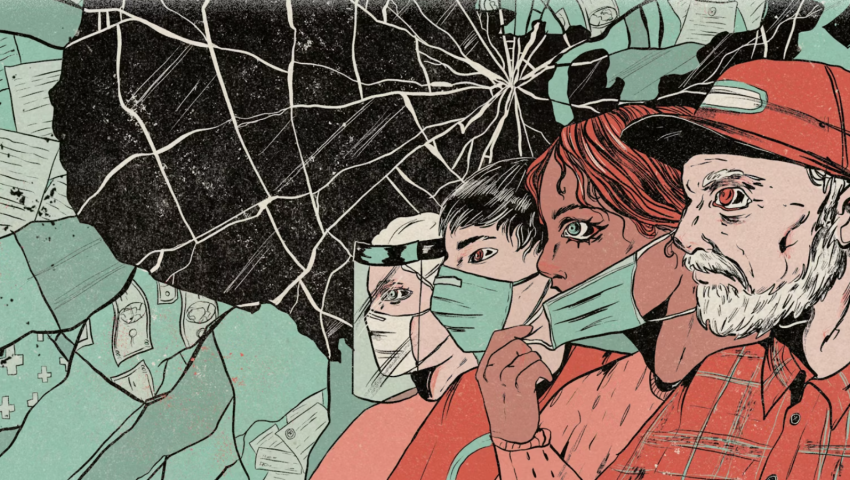
The Pandemic Generation Isn’t Behind; We’re Still Rebuilding What Long‑Term Wellness Really Looks Like for Young Adults Who Grew Up in Crisis
The year everything shut down, I looked like the kind of teenager adults pointed to as proof that
kids were “resilient.” I kept my camera on. I turned in every assignment. I held onto my
straight‑A transcript like it meant I was fine.
What no one saw was the bottle of vodka in my desk drawer or how easily I could perform
competence when the world stopped asking anything of me. The lack of structure didn’t just
loosen my life, it hollowed it out. And like so many others, the pandemic didn’t create my
mental‑health issues, but it poured gasoline on them.
Someone I love spiraled even harder. They were barely engaging with their classes, missing
deadlines left and right, and my mother and I spent that whole semester practically dragging
them through it. We reminded them, organized everything, begged them to try, sat with them for
hours trying to coax even a few sentences out of them. We did everything short of doing the
work ourselves just to keep them moving toward a finish line that had already stopped mattering
to them. They graduated anyway. They dropped out of college within months.
Years later, I see the same pattern everywhere: Young adults trying to swim with muscles they
never got the chance to develop.
The long‑term effects didn’t fade. They aged with us.
National data showed that young adults kept reporting elevated anxiety and depression long
after older groups stabilized. But you don’t need data to see it. You can see it in the way so
many of us talk about burnout like it’s a personality trait. In how stress tolerance feels thin. In
how “normal life” still feels heavier than it should.
COVID didn’t just interrupt school. It interrupted the formation of the skills that make adulthood
possible.
And the fallout shows up in our careers, too.
I’m taking five years to finish a four‑year nursing degree, not because I’m unmotivated, but
because the scaffolding I was supposed to build my life on wasn’t there when I needed it.
My peers tell the same story in different contexts:
- A friend with an architecture degree working as a barista
- Someone with an exercise‑science degree serving tables
- Marketing grads, IT grads, lab‑tech grads, all stuck in “entry‑level” jobs that require three
years of experience
It’s not that we’re unskilled.
It’s that the pipeline into adulthood jammed right as we were supposed to enter it. It’s the result
of when the world demands too much and provides too little.
This isn’t a character flaw. It’s a timing wound.
The pandemic hit at a developmental moment when stress tolerance, executive function, and
identity formation were still being built. Expectations returned instantly when the world
reopened, but the skills needed to meet them didn’t.
So what now?
I don’t think the answer is pretending everything is fine or telling young adults to “catch up.”
Maybe the first step is simply acknowledging the truth:
We were asked to build adulthood on disrupted ground.
And maybe wellness, for this generation, starts with understanding why so many of us feel
overwhelmed, scattered, or perpetually behind, not as a personal failure, but as a
developmental aftershock.
We’re not behind.
We’re rebuilding.
And rebuilding takes time.
Sources:
Allmang, S., Plummer, J. A., Copeland, V., & Riascos, M. C. (2022). Untangling the effects of
COVID‑19 on youth employment: Directions for social work research. Journal of the Society for
Social Work and Research, 13(3). https://doi.org/10.1086/720981
Anderson, L. R., Hayward, G. M., McElrath, K., & Scherer, Z. (2023). Work and lifestyle of young
adults changed during the pandemic. U.S. Census Bureau. Work and Lifestyle of Young Adults
Changed During the Pandemic.
Bureau of Labor Statistics. (2025). Employment and unemployment among youth summary.
Employment and Unemployment Among Youth Summary - 2025 A01 Results.
Mota, C.P., & Ferreira, M. (2025). Loneliness, self-control and challenges of the COVID-19
experience in the academic adaptation of young adults. Current Psychology, 44, 18496 - 18510.
Vahratian, A., Blumberg, S. J., Terlizzi, E. P., & Schiller, J. S. (2021). Symptoms of anxiety or
depressive disorder and use of mental health care among adults during the COVID‑19
pandemic—United States, August 2020–February 2021. Morbidity and Mortality Weekly Report,
70(13), 490–494. https://doi.org/10.15585/mmwr.mm7013e2